

| home | | | past | | | present | | | traditions | | | people | | | photos | | | site | || | the ATOM | | | school photos |
| home > the past > the story | South Shields Grammar-Technical School for Boys | | |||||||||||||||||||
| ||||||||||||||||||||||
| About the School - a potted history last revised: 13-Jun-2003 |
|
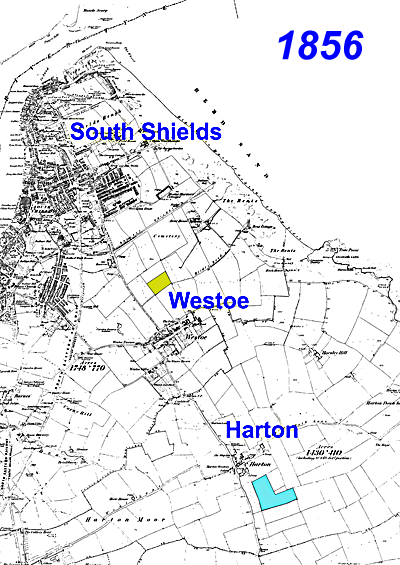
Education in the 19th century So said a government inspector's report in 1853. Yet at that time, there were 10 public and 30 private schools in the Borough serving the "lower classes", and a further 18 private schools for the "middle classes". This was at a time when most of the population lived in a small area close to the river, as can be seen in the 1856 map to the right. Schools were largely provided by the church or by companies for their employees, and they charged anything from 1d to 6d a week (orphans, children of widows and from the Poorhouse were sometimes able to receive a free education). This was a marked improvement on the area's education of about 120 years previous, when there were only two schools. In 1871, under the provisions in the 1870 Education Act, South Shields was one of the first boroughs in the country to set up a School Board, which was quick to acquire and build schools all over the borough. Ocean Road saw the building of one of the largest schools in the north-east, serving 1500 children. A second big school, with 980 places, was built in Cone Street (near the Mill Dam, off Commercial Road), and plans were laid for many other schools, including the taking over of a number of company schools. The Boys' High School is born There was already a Girls' Public Day School Company which had founded a number of schools around the country, including the Girls' High School in Gateshead. A company for boys' schools was set up in 1882 for the provision of higher intermediate education for boys throughout the country. Its objectives seemed ideally suited to the town's needs, and the Company was asked to provide copies of its prospectus to Malcolm and his group. Many quickly offered their financial support for the project by agreeing to buy shares in a school built under the Company's guidance and on January 19th, 1883, the local MP presided over a public meeting in the Marine School which resolved to enter into discussions with the Company. An appeal was made to the Company to select South Shields as a location for one its "branch schools", and a local committee formed to enter into business relations with the Company. On 28th April, 1883, the Company sent Professor T Hayter Louis to South Shields to hold an inquiry. Initially they were looking at proposing a "standard" public school in South Shields, but after Louis met with Samuel Malcolm, Mason Moore (Town Clerk) and Alexander Scott (Head of Ocean Road schools), the recommendation was for something a little higher - a school whose pupils could go straight on to university. The go-ahead was given by the Company, but only if at least a thousand shares (at £2 each) were taken up.
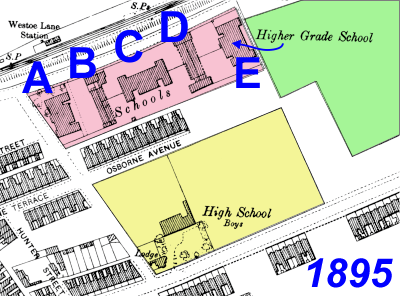
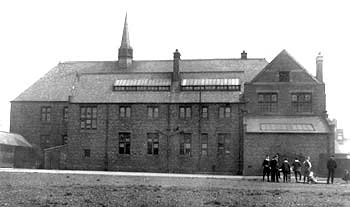
The president of the Boys' Public Day School Company, Lord Aberdare, laid the foundation stone on May 29th, 1884. Just a year later, in May 1885, 37 boys were registered and took up their places in the new High School, under the headmastership of WH Phillips, and by the end of the year there were 67 boys attending. The two-storey building cost £6000 to build, and had a separate block for the caretaker and dining hall. The map on the left, from 1895, shows the school and its grounds coloured yellow, with Mowbray Road running along the south. Westoe Higher Grade and Westoe Secondary The 2.5 acre site, just north of the High School and coloured pink in the map above, was acquired in 1888, and built by the School Board at a cost of £16,640 (roughly equivalent to £16m these days). Designed to accommodate 2003 children (making it the largest Board School in the country), the schools were opened in January, 1890. Building A was the Westoe Infants School and the central building (C) was the elementary school (for ages 7 to 11). Buildings B and D were outhouses linked by a covered area. At the north of building B was the caretaker's house, while building D had a cookery centre at the north end, a laboratory at the south, and what is though to have been a toilet block in the middle. But it is building E, the Westoe Higher Grade School, that is part of our story. It was formed as an "organised science school", and accommodated Alexander Scott and his pupils from the science and art section of the Ocean Road Boys' School. In 1902, a new building was completed to the east of Westoe Road Schools (the green area on the 1895 map, with Iolanthe Terrace built between them), and Westoe Higher Grade School moved into it, while the original (building E) was redesignated as Westoe Central School. In time, the Westoe Higher Grade School was to become Westoe Secondary School, and later still, the Girls' Grammar School. The Grammar School This was a private school, The
Boys' High School fails In the end, in 1891, the school buildings, the grounds and the school's debts were sold to the South Shields High School Company Ltd for £4500. Yet even this company struggled, with daily school attendance never rising above seventy boys . Running costs were being covered, but only £1195 of the original capital costs of £6000 had been funded and interest on the outstanding amount continued to accrue. Yet, with debts continuing to rise, the governors went ahead and built a new science and art wing at a cost of £1800, which was opened in 1899 by old boy, and Oldham MP, Walter Runciman.
From this point on, matters improved significantly, with school admissions rising considerably. By the early 1930s a number of "huts" had been erected to accommodate the growing numbers, and folding screens were erected in the hall to provide two additional classrooms. The governors urged the council to consider the erection of a new Boys' High School. Around the same time, what was by now the Westoe Secondary School was also running into accommodation problems, and in a letter to the authority the school proposed that the existing school be replaced by separate secondary schools of "substantial size" for boys and girls. The
Boys' High School develops
Although earmarked for an elementary school, nothing happened for four years and in view of the accommodation crisis in the Boys' High School and Westoe Secondary School, permission was sought to change the use of the site and build a new High School for Boys. But despite the crisis, the Board of Education refused permission saying, in April 1932, that "the project is not sufficiently urgent to justify the contemplated expenditure in present circumstances". Over the following 15 months several attempts were made to get the Board to change its mind, but every time the Board was "unable to modify [its] previous conclusion". In July 1933 the local MP (Harcourt Johnson) and Colonel Chapman, "interviewed" the Under-Secretary of the Board of Education regarding the provision of secondary and central education in the borough. Just a week later, the School Board wrote that it was now willing to consider the proposals and in two months the Finance and Works Sub-Committee of the council appointed George R Smith as the architect for the new High School, with applications being made to the Ministry of Health for the sanctioning of the necessary loans to cover the building costs. The final hurdle was the approval for the change of use of the site from elementary to secondary education, and this was given in July, 1935. The new building The ground-floor plan of the building is shown below, re-drawn from the original architect's plans.
The southern corridor was a full 445 feet long - at its east end were the metal- and wood-workshops, while at the west end was the gym and an open walkway to a small toilet block. At the heart of the school was an oak-panelled assembly hall intended to seat 550 pupils. This hall, with its floor of American oak, had a fully-equipped stage and an organ paid for from funds raised by the High School Old Boys' Association. The stage ran along the north side of the hall, and the south corridor of the school was widened at that point to create a "crush" area.
But great care was taken to ensure that the building could be expanded to cope with future needs. Although there was only a ground floor to the rear, it was designed to allow a second storey to be added if required. Built at a total cost of £60,000 (£5.5m today) the school was opened in 1936 and called the South Shields High School for Boys. Its pupils were drawn from two schools - the original Boys' High School in Mowbray Road, and the boys from the Westoe Higher Grade School, in Iolanthe Terrace. The headmaster was WT Lucas (Head of the Mowbray Road school) and the Deputy Head was TE Newby (Head of Westoe Secondary School).
However, the opening ceremony went ahead as planned on 10th of September, 1936. It was a somewhat elite affair; with only the Vth and VIth forms being permitted to attend. The great-and-the-good in education came from all over South Shields, and the platform party, shown in the photo, included the Lord Bishop of Durham, Colonel Chapman, Councillor Hill (the Mayor), Chuter Ede MP, the Reverend PFA Walter, Alderman J Ranson, Mr GS McIntyre and the architect, Mr George Smith. The headmaster, WT Lucas, lived in Sunderland Road, which runs close and parallel to the St Mary's Avenue side of the site and with the houses backing onto those in St Mary's Avenue. In fact, Bill Lucas's house backed onto the house owned by Mr Carruthers, the builder of the school. Lucas had a special agreement with Carruthers that allowed him to cut through to the school without walking all the way round.
The school grows The upstairs back corridor was added, with staircases at each end of the downstairs back corridor, and the school hall was expanded by turning it through 90 degrees and building a bigger stage in the west quadrangle. The "manual" rooms (woodwork and metalwork) were relocated to a new Technical Block built at the west-end of the playground, and a new gymnasium was built at right angles to the old, with new changing rooms built between it and the back corridor. Anyone who went to the school after 1955 might recognise the gym windows in the 1936 photo above - the gym corridor (linking the gym staff room, the changing rooms and the back corridor) was built along this wall. The windows were simply left in place, making it possible to look into the small gym from the corridor.
Just after the rebuilding was completed, Mr Lucas retired, and was succeeded by W (Bill) Egner. Egner was a powerful figure, but with some quirky ways! However, he was also a very progressive headmaster and introduced many innovations to the school, which by now was called the South Shields Grammar-Technical School for Boys.
During the 60s, Russian was added to the syllabus, the prefects system was abolished, a coffee vending machine was installed for pupils and, for many of us the highlight of the 60s, in 1966 the school was given a computer.
A handful of us spent much of our spare time in that computer room. It was nursed by Fred Palin, one-time electrician at Binns, who had the job of replacing broken valves on a nearly daily basis. There was no direct input (other than a few switches on the front panel), nor any direct output (apart from a few flickering dots on an oscilloscope screen), but between us we managed to get it to do everything from play noughts and crosses to playing tunes. Bill Egner had the grand idea of producing the school timetable on the computer - but the Pegasus itself was old technology, and not really up to the job. He did go to Norway to get the school timetable produced there, and in 1971 the school was reported to be the first in the country to have its timetable produced on a computer. In the early 70s, there was a great deal of change in education. In 1973 came the Raising Of the School Leaving Age, ROSLA, from 15 to 16 - but the effect on SSGTSFB was minimal. Here, the minimum leaving age was already 16, and had been for a long time. Boys in the 4th forms, who once may have looked upon their contemporaries in other schools with a degree of envy in their ability to leave and get a job, now had equal leaving status. But the greatest change introduced was that the 6th form was opened up to all-comers, with 5th-formers from all schools in the area being afforded the opportunity to apply for a place. In 1974, education underwent some major changes with the decision of the Department of Education and Science giving approval for the "comprehensivisation" scheme - and with these came big changes for the Boys' High School. On 1st September 1974, the name of the school was changed to Harton Comprehensive School, and the first year intake of 180 boys was no longer based on selection but was simply from the school's catchment area. It was unusual for a comprehensive to be single-sex, and this changed five years later when it went co-educational (although the arrival of the girls was delayed, as the girls' toilets were not completed in time for the start of the term. much the same as had happened at its opening in 1936) Changing times - into the 21st century As teaching needs changed, particularly in curriculum and techonology terms, and the school's fabric deteriorated, numerous minor building projects were carried out around the site. A new library and community building was constructed on the site of the old "canteen" block. The "Art Block" became a dedicated music block (with a practice room, small studio and "keyboard lab"), and the art department was accommodated in an extension to the "Technical Block". A new Information Technology building was built in the main playground, housing the ICT department. And in 2001, the school got a share of the government's Private Finance Initiative to build a new sports hall. This was completed in 2005 (and extended in 2012), and included a large 4-court hall and a fitness suite. It was opened as Wellness at Harton, and as a community facility, funded by its users. It wasn't just the buildings that changed - the school changed its name again - twice. From Harton Comprehensive School it became Harton College and then, on receiving technology specialist status, it changed to Harton Technology College. The seeds of the school's biggest change started in 2003, when the government announced a new development programme to rejuvenate secondary schools in England. South Tyneside Council got on board, and Harton Technology College was amongst a number of South Shields schools set to benefit from more than £160m of investment, under the Building Schools for the Future (BSF) scheme. In December 2007 a Local Education Partnership was formed between South Tyneside Council, Gateshead Council, the Royal Bank of Scotland, Building Schools for the Future Investments and the developer, Carillion. And in 2008, planning started on the redevelopment of the site. Initially, thoughts turned to flattening the site and starting from scratch. Although it may have been an architect's ideal, it would have destroyed the school's heritage. Even though the old building was only 70 years old, it was of significant architectural and community importance. As plans were being developed, Harton's outstanding performance led the government to invite it (amongst only 12 schools in the country) to re-establish a Sixth Form, and funding of around £7m was offered. With funds from BSF plus the Sixth Form initiative, a total of around £25m was available for the work - and the proposed new plans involved two phases. The first was to construct a new 260-place Sixth Form and Technology building (which would also house the site's catering facilities) opposite and complementary to the old building. Construction was expected to take a year, after which the old building would be emptied and refurbished. Pupils would be taught in the new buildings and in temporary classrooms built on the playing fields by St Mary's Avenue. Plans were completed and laid before the Council's planning department early in 2009, and from the outset energy efficiency was high on the list of design goals. Approval was formally issued on 6 May 2009, and work started in earnest soon afterwards. On schedule, the new Sixth Form and Technology building opened a year later, and the first Sixth Formers for 22 years arrived on site in September, 2010 - at which point, with the 1936 building closed for its refurbishment, the main school opened in temporary classrooms. The old building was set to re-open in September, 2011, but the discovery of asbestos under floorboards in April 2011 set the timetable back and it re-opened in November. |
| ||||||||||||||||||||||
| This site and its design and contents are copyright © Mike Todd, 2001-2014 - school copyright is acknowledged - contact me | ||||||||||||||||||||||
 A
4-acre site adjoining Mowbray Road was earmarked (the yellow area
on the maps), and a sale agreed with the Ecclesiastical Commission
for the sum of £1870. To speed up the process, the local local committee
guaranteed this sum, and plans were quickly drawn up for a building intended
initially for 200 boys.
A
4-acre site adjoining Mowbray Road was earmarked (the yellow area
on the maps), and a sale agreed with the Ecclesiastical Commission
for the sum of £1870. To speed up the process, the local local committee
guaranteed this sum, and plans were quickly drawn up for a building intended
initially for 200 boys.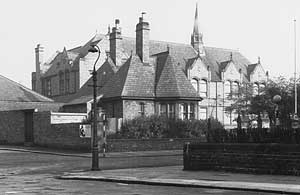
 In 1902, the new Education Act abolished all school boards, with responsibility passing to the new Local Education Authorities, but the Boys' High School continued to operate as a limited company. However, it was eventually sold to the local authority in 1908 for £8562.
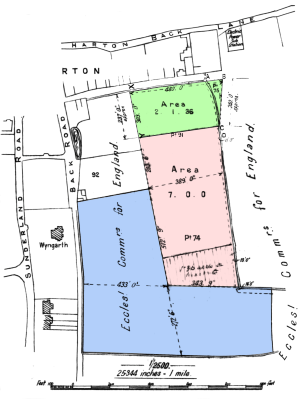 The plan on the right shows the plot in blue. The pink and green areas had already been sold by the Commissioners some years previously to the Smith's Dock Company Ltd, who in turn sold it to the South Shields YMCA in 1925 (the plan is taken from the 1925 conveyance). The road at the top of the plot was to become Marsden Road, and the section coloured green became Fairview Avenue.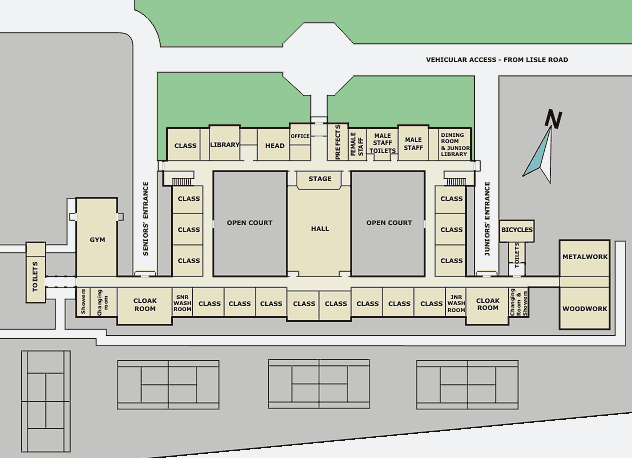
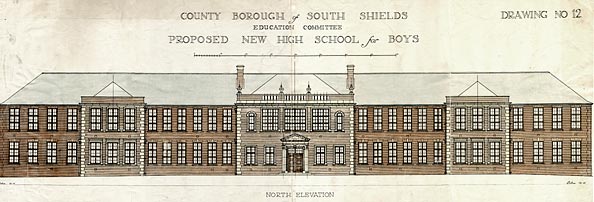 The
architect's drawing for the front elevation is shown on the right. At
its centre is the "spacious entrance vestibule with a pediment doorway".
Inside, the vestibule was oak-panelled with a York-stone pavement. Most
of this north frontage contained "the principal administrative rooms,
such as the Governors' room (with which is combined the School library),
headmaster's room, secretary's room, prefects' room, staff rooms, a small
dining room and junior library combined".
The
architect's drawing for the front elevation is shown on the right. At
its centre is the "spacious entrance vestibule with a pediment doorway".
Inside, the vestibule was oak-panelled with a York-stone pavement. Most
of this north frontage contained "the principal administrative rooms,
such as the Governors' room (with which is combined the School library),
headmaster's room, secretary's room, prefects' room, staff rooms, a small
dining room and junior library combined".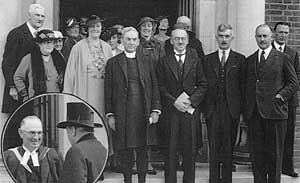 The building was occupied by staff on 7th September, and the start of the school year was planned for a few days later. Unfortunately, several
parts of the building, the laboratories in particular, were
not yet fully furnished, so the boys were given an extra few days holiday - joining the school on Monday, 14th September.
The building was occupied by staff on 7th September, and the start of the school year was planned for a few days later. Unfortunately, several
parts of the building, the laboratories in particular, were
not yet fully furnished, so the boys were given an extra few days holiday - joining the school on Monday, 14th September.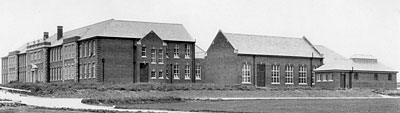 The
photo on the right shows the view of the school shortly before it opened. This is taken from the
playing fields along St Mary's Avenue and shows the front of the school, with the gymnasium to
the right. Also, keen-eyed boys who were at the school after the mid 50s will spot the fact that
the upstairs at the back of the school is missing - the school was actually just a single storey
along the back corridor, although there is a first floor greenhouse just visible in the photo.
The
photo on the right shows the view of the school shortly before it opened. This is taken from the
playing fields along St Mary's Avenue and shows the front of the school, with the gymnasium to
the right. Also, keen-eyed boys who were at the school after the mid 50s will spot the fact that
the upstairs at the back of the school is missing - the school was actually just a single storey
along the back corridor, although there is a first floor greenhouse just visible in the photo. 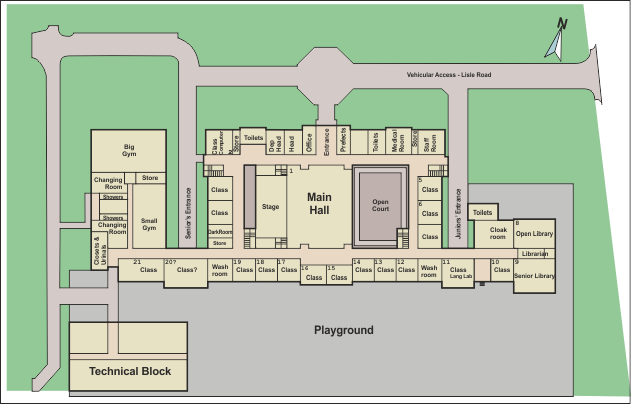
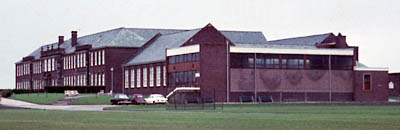 In
1964, to the north of the main building, a new Arts Block was opened, including a music room, replacing
the one located at the end of the Technical Block. In 1965, a swimming
pool was opened, and the photo to the left show the site (from almost
the same viewpoint as the 1936 photo above) in 1969.
In
1964, to the north of the main building, a new Arts Block was opened, including a music room, replacing
the one located at the end of the Technical Block. In 1965, a swimming
pool was opened, and the photo to the left show the site (from almost
the same viewpoint as the 1936 photo above) in 1969.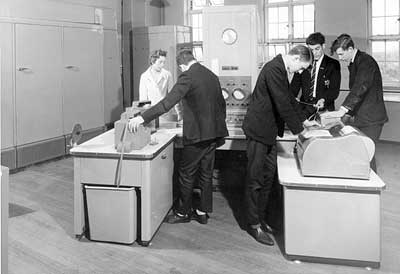 The
computer was a Ferranti Pegasus. As can be seen from the photo on the
right, it took up a whole classroom (room 2), with a caretaker's cupboard
opposite housing an alternator. For those of us able to get our hands
on this beast, usually under the tutelage of Miss Avril Emsley (on the
left in the picture), these were very exciting times.
The
computer was a Ferranti Pegasus. As can be seen from the photo on the
right, it took up a whole classroom (room 2), with a caretaker's cupboard
opposite housing an alternator. For those of us able to get our hands
on this beast, usually under the tutelage of Miss Avril Emsley (on the
left in the picture), these were very exciting times.